Friday, 13 May 2011

Taking Beekeeping to a Higher Level - Part 2

Finally got around to updating the "story so far". Just before Easter I put together some equipment.
The modified crown board is equiped with a porter bee escape which only allows the bees out but not back in again.  A foam rubber strip around the edge compensates for uneveness of the stonework.
The other side has a plastic ready-meal container with a hole in the bottom to take a plastic 1 inch basin overflow pipe.  I have also put a one inch hole in the back of a standard brood box.  There are a couple of frames with stores in and a couple of frames with old comb.
I took this lot back to the site and was very pleased to discover that the whole lot including my tool box could be lifted up to the top of the scaffolding with a fork lift crane.  I put the box in position and put the board over the holes in the chimney.  A piece of stone and a lightweight concrete block held it in place.
I left the site and because of the extended Easter and Royal Wedding Bank Holidays had to leave them for rather longer than I was anticipaing.  Unfortunately, in the intervening period the board must have shifted a bit and the bees have worked their way around the foam at the top.
The other day I went back and with the help of one of the carpenters we have repositioned the board and sealed around the outside with expanded foam.
 Spot the handsome beekeeper in the high vis jacket!  Hopefully this will now encourage them to use the box as the entrance and move their operations and queen there!

Wednesday, 20 April 2011

Taking Beekeeping to a Higher Level

I do enjoy life in the Cotswolds, and particulaly the challenges that pop up from time to time once word gets around that you are a rural beekeeper.  I got a call from a construction company with a bee problem the other day.  They are renovating an old farmhouse and have discovered that not all the previous tenants have moved out.  It would seem that a colony of bees has made itself at home in one of the chimneys.  I usually view such requests with some trepidation.  Most beekeepers, me included, tend to like to have both feet on the ground when dealing with bees.  Catching a swarm in a tree can be challenging and often taking the easy way out (leave them to it!) if they are too high to be retrieved safely is the the best option.
With houses, chimneys and roofs there is no "leave them to it" option.  Fortunately the construction company in question is very keen to do whatever they can to conserve wildlife and particularly ensure that bees are looked after.
When I arrived at the site I realised that this was not a "balance on the top of a ladder" type job and after signing in and getting my hard-hat I was guided to a two storey ladder and onto scaffolding.which has been placed around the house and gable end chimney. On a gloriously sunny day with wonderful views of the surrounding countryside, I could see what attracted the bees to their current property!
Donning my bee jacket I went up on the chimney scaffolding and had a look at the situation.
There were a lot of bees coming and going through gaps in the mortar on the face of the chimney.  Aparently there are two flues, one that will be relined and opened up and one that has been blocked off, Fortunately they are in the blocked off side and by the number of bees I would say that they have been there since at least last year.  It is probable that they will be swarming soon.  As you can see  the entrance is actually at a very convienient height given the scaffolding! However it would be better to try to avoid taking stone blocks out of the chimney and pulling them out enmasse if possible  Having discussed timescales I was very releived to discover that there is plenty of other work that can be done on site so we have the luxury of a few weeks to sort this out.

I am proposing to put a cover over the entrance with a short pipe attached which I can insert into the back of a spare broodbox with some foundation and old comb to make a new hive.  This will have the effect of moving the entrance to the otherside of the brood box and encourage them to expand the nest out into the box.  After a few days I will put a no return valve in so that all the flying bees and newly hatched bees will have no choice but to take up residence in the box and hopefully the queen will then join them there and establish this as the new home.  After a few weeks there should be no more bees in the chimney and we can then seal up the old entrance with mortar and take the colony back to the apiary.
That's the plan anyway.  If any of you beekeepers out there have any suggestions or "gotchas" that I might need to consider please leave comments below or talk to me on Twitter.
I will, of course, keep you posted on how this works out!

Wednesday, 6 April 2011

A Warm Spring Afternoon


Another lovely warm day in the Cotswolds today. Went for a walk with camera and bee jacket. The Magnolia is out, and looking very splendid it is too. This has been a key feature of the village for a long time and its blossoming a keenly awaited event.

Further down the road I passed one of our neighbour's fields. He is helping out the Donkey Sanctuary by giving a home to some abused donkeys. Why anyone would want to treat donkeys badly, I can't imagine but it looks like they are having a nice time now. They have a large field to themselves and are clearly enjoying the spring sunshine.
I had a quick look at the bees, they seem to be building up nicely and there is plenty of pollen and nectar coming in. The Dandelions are out which is good. The bees love them and they make very nice honey.

Monday, 28 March 2011

Spring Blossom


I had a wander around the village this afternoon. Another brilliantly sunny day. The cherry blossom at the church is out and was covered in bees of all sorts. This picture is of a bumble bee getting stuck in! The air was alive with the sound of bees buzzing and birds singing.
A lot of my bees had found there way up here and were grabbing as much nectar as they could carry away.


Here is a bit of video I took of the activity.


We had a group of 12 potential beekeepers over to have a look at our bees yesterday afternoon. They had had a days introductory course a couple of weeks ago and this was their first oportunity to experience the real thing. When I arrived to meet them, Chris, our training officer was over the road with them watching the bees working the catkins at the stables. I had a look this afternoon and they were still at it!

We walked down to the apiary fully suited (probably looked like some environmental disaster was in progress!). We had a good look through most of the hives and it would appear that we have four very strong colonies, two a bit on the small side (gave them a feed in the hope that it would tide them over till they have enough foragers), and one colony that didn't make it through winter. They were very small in autumn and I was probably being over optimistic.
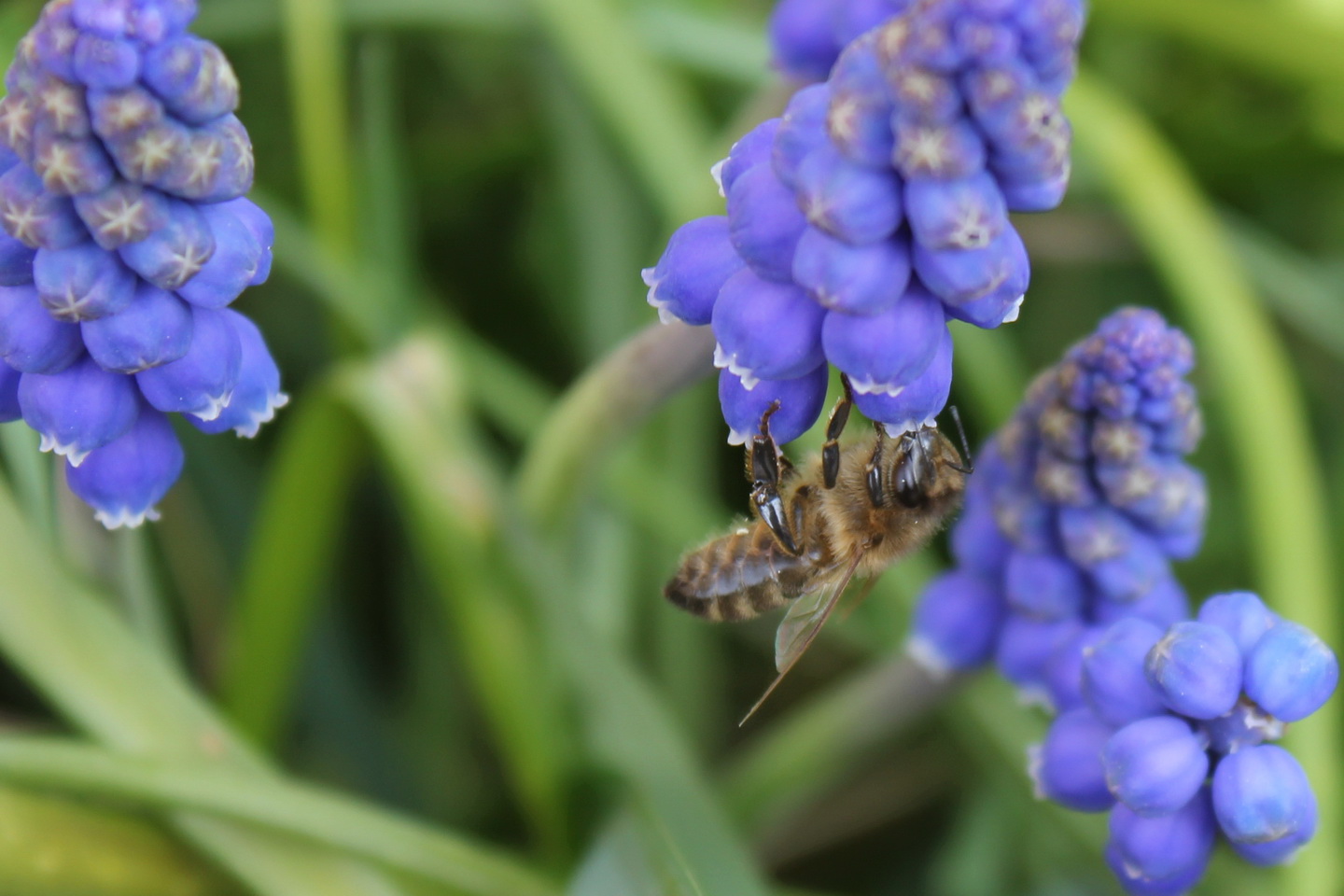
On the way home I noticed the Grape Hyacinths were also receiving attention from the bees. So it looks as though there is plenty around to keep them busy.

Friday, 25 March 2011

Spring is coming along nicely


Spring seems to be coming a little earlier than usual this year and we are all enjoying a spell of warm sunny weather. There are lots of flowers blooming early, particularly the daffodils. The bees are also enjoying the weather and there are signs of an early start to laying by the queens. When eggs are hatching the nurse bees need lots of pollen and honey mixed to feed the new grubs so they will have been digging into what is left of the winter stores. As you will see in this bit of video I took this afternoon, there is plenty of pollen being brought in.


As the main nectar bearing crops arent out yet there is not a lot of nectar about yet so this can be a problem. If they are running short of honey then there is a real danger of starvation even in the warm weather. I popped down to the apiary to have a quick look under the crown boards and establish how things are going. There are two colonies that are very light so I will give them a supplimentary feed of 50/50 syrup (1ib to 1 Pint of water). The other 4 colonies are very strong and the brood boxes are heavy so they should be OK. One colony didnt make it through the winter - they were very week at the end of last season.
Of course the early start to the season may well mean an early start to swarming so we will have to keep an eye out for that and manage accordingly. We normally have first swarm around the end of April but something tells me this year will be a lot earlier.

Friday, 28 May 2010

The Show Must Go On!

My wife Julia, (@RedJoules ) is a director of the theatre production company Tigz Productions Ltd. Every year they have put on a show in which a young "amateur" cast of singers, dancers and actors gets the opportunity to present a "West End" show. They use professional coaches to train them and use all their professional technical resources to present the show. The term "Amateur" in this context does not do justice to the level of professionalism that is reached. They have to pay 15% of ticket sales to Josef Weinberger for the rights to perform it but this allows them to use material from an established show. The cast are all intending to make this their profession and this is their first foot on the ladder, it gives them a showcase to help them get paid employment and develop their talent.
Unfortunately grants are not forthcoming for this sort of activity and the only source of income is the personal investment of the directors of the company and revenue from ticket sales. It is true that the company would hope to get some marketing benefit as a demonstration of their skills to potential clients but they are really just hoping to break-even.
In the current economic climate, marketing a show of this kind is very difficult. The traditional methods using local news advertising and flyers are extremely expensive and have a very low hit-rate. However the ticket price is very reasonable at £12 (£10 if you mention Twitter!) so it is all about getting as many people in to see the show as possible.
It seems to me that this is the ideal type of activity that Twitter should be able to help with. They just need as many people who can get to Cheltenham on the 3rd, 4th or 5th June as possible know about the show. £10 for a night at the theatre is not a lot to pay individually but the combined effort will mean that the company can continue to provide a showcase for local talent.
As for the show itself – come along and see for yourself. Follow the cast's @TigzOurHouse acount for updates and preshow snippets and have a look at the Website There are loads of photos of previous shows and some Youtube clips too.
Please help by Tweeting about it (use the #TigzOurHouse hashtag) and tell your friends.

Sunday, 18 April 2010

The Political Hive - What can Bees teach us about politics?

At this time of the year beekeepers up and down the land are peering into their hives, checking for signs that the queen is laying properly. There must be enough food to sustain the development of the colony and there must be enough room for the colony to expand to build a foraging force to exploit nectar and pollen provided by the local flowers and trees.
We are approaching the "Swarming" season. This is when the colony decides whether they are happy with the performance of the current queen and that there is enough resource available to continue in the current hive. If they decide it is time for a change then the Beekeeper will see the signs. The worker bees will start creating special cells in which to raise new queens. They will select day-old larvae to populate the cells and feed and nurture these larvae with special hormones and "royal jelly". In a couple of weeks the new queen will hatch out. The existing queen will have left the hive with all the foraging force of flying bees. This is the "swarm" which will have already selected a suitable new location in which to live and a new colony will be established.
So what has all this got to do with politics? Well...
We are in the midst of an election, we as a nation are deciding whether our current leaders are fit for purpose and whether there is sufficient resourse available to continue in the current "hive" or whether it is time for a change. This is a decision which we make collectively for the good of the colony as a whole although most of us will have personal considerations to take into account. We are not bees so we are not constrained by the ruthless logic imposed by our biology and the thought process is probably a great deal more complex than that of the humble bee.
However if we look at this from the persepective of the Beekeeper things start to get more interesting. You might think that the best way of ensuring a good honey crop is to have as big a hive as possible, economies of scale, more bees mean more honey. Up to a point this is true. The problems start when the hive gets too big to manage. A smaller hive can be quickly looked through every couple of weeks to check all is well. The bigger it gets, the bigger the task of managing it. Hives are made up of individual boxes of matching sizes made to a standard pattern and years of experience, experimentation and developement have provided us with two or three basic manageble hive types. At some point you need to split the hive into two to bring it back to manageable proportions. No beekeeper would want to have all his bees in just one hive. If something goes wrong his entire "apiary" is at risk. Of course one could imagine all kinds of technical innovations that may assist the beekeeper in ensuring that his one hive doesnt fail. He could set up cameras, heat detectors, inspect every day, record every movement and run statistical analysis in a laborotary environment. All of this is possible but hugely expensive and completely unnceccessary. Bees can do quite a good job of managing themselves so long as their colonies are not allowed to get too big. The wise beekeeper tries to manage the colonies in tune with the natural behaviour of the bees. It is in the bees best interest to build strong colonies and work efficiently, they do this with very little need of encouragement. If there are signs of disease then they can be treated. If a colony is clearly struggling it can be combined with another or frames of stores can be taken from strong hives and given to those with not enough.
It is important to note that bees manage themselves so well because they have a supremely efficient communication system and each bee takes responsibility for their allotted tasks.
Our political system has evolved over the years to favour central management of a monolithic state machine. The assumption has always been that economies of scale will lead to value for money and efficient government. The only reason this may have been true in the past is because we have not had anything like the same level and sophistication of communication that we have today. When the mechanics of decision making are supported by very slow and unwieldly processes you need to keep the physical distances between the parties in those conversations as small as possible. Therefore it makes sense to build huge office buildings and and huge organisations that can afford to run those buildings. The task of managing this is enormous and demands huge resourses just to keep the process running. The management overhead has now got to the point where it is unsusstainable and as with the beehive is actually becoming completely unnecessary.
In the coming election I will be looking at those candidates who genuinely have a desire to start making some radical changes to the way the government runs things. The collapse of the banks has given us all the wake-up call that allowing big business to get "too big to fail" is not a good idea. Global warming is telling us that we have very little time left to reduce our dependence on fossil fuels. The growth of the internet and development of highly sophisticated technical means of realtime communication is capable of giving us the way out or our current troubles. So long as the government can manage not to sabotage it with ill-informed interference. So long as self-interested big business can be persuaded not to exploit and trivialize it for their own ends and so long as genuine criminal elements can be persuaded to stop sabotaging it. We as a society must start communicating with eachother properly with a view to rebuilding our local community spirit. We need to allow people to feel responsible and proud of the part they are individually playing in building the future. We need to give small businesses the facillities to provide long-term susstainable employment to their local communities. Of course the term "local" is no longer necessarily tied to its geographical sense. The new communities can contain valuable contributing members from anywhere in the world.
So in my view, the bees can teach us that the way to prosperity is through small scale local responsibility. We build to manageable sizes and then split to form the basis of new enterprises and just keep communicating with eachother.